OFSDA Official Organogram (2026)
Hierarchical organizational structure connecting the Board of Directors, Executive Director, Deputy Director, and the three operational departments: Program, Finance, and Operations.
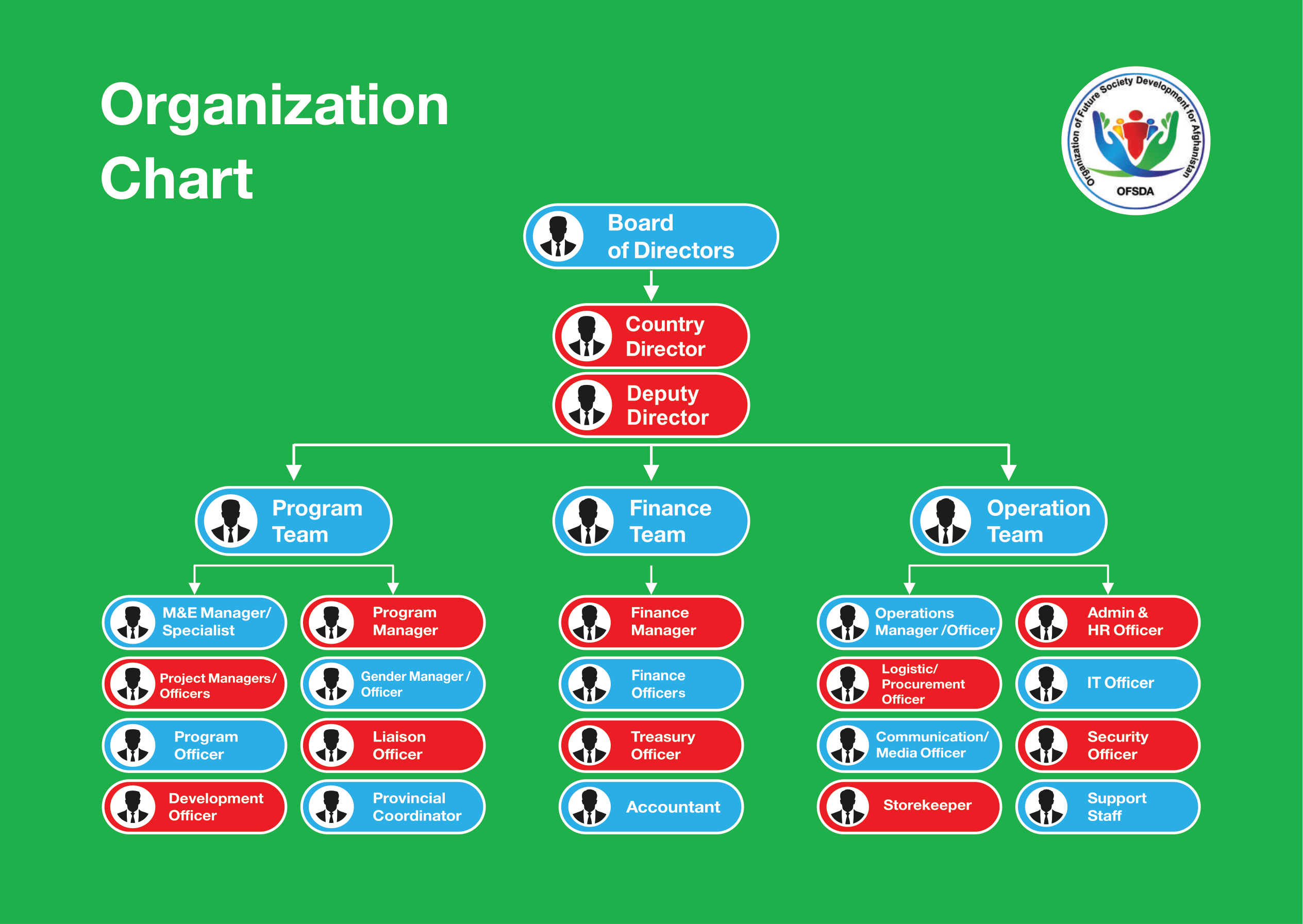
Click on the chart above to inspect the high-resolution structure in fullscreen lightbox mode.
Download Organogram ImageGovernance & Management Structure
OFSDA’s structure establishes clear responsibility for strategic oversight, executive leadership, programme delivery, financial stewardship, and organizational accountability across 7 core tiers.
Board of Directors Senior Governing Body • 7 Members
The Board of Directors comprises seven members, including OFSDA’s Executive Director. The Board is led by a Chairperson elected or selected annually through a rotating arrangement in accordance with OFSDA’s constitution. The positions of Board Chairperson and Executive Director remain strictly separate to maintain a clear boundary between governance oversight and executive management.
Principal Board Responsibilities:
- Approving organizational strategy, annual plans, budgets, and major policies.
- Overseeing compliance with constitution, donor agreements, and MoEc regulations.
- Appointing and evaluating the Executive Director and approving executive deputies.
- Reviewing financial performance, risk assessments, and independent audit findings.
- Overseeing safeguarding, anti-corruption, conflicts of interest, and reporting.
- Ensuring organizational continuity, leadership succession, and donor accountability.
Executive Director & Executive Management Ansarullah Danish • Executive Leadership
The Executive Director reports directly to the Board of Directors and is responsible for translating its strategic direction into effective programmes, sound operations, and measurable organizational results. The Executive Director chairs the Executive Management Team and Senior Management Team, working through designated programme, finance, operations, and technical functions.
Executive Responsibilities:
- Leading implementation of OFSDA’s strategic plans within approved budgets.
- Providing overall oversight of programmes, operational performance, and staffing.
- Leading donor engagement, fundraising, partnerships, and external representation.
- Integrating safeguarding, inclusion, and risk mitigation into field operations.
- Delivering accurate quarterly performance and financial reports to the Board.
- Documenting corrective actions from audit and monitoring findings.
Head of Programmes Master's Degree • 6+ Years Experience
The Head of Programmes reports to the Executive Director and leads programme design, proposal development, provincial coordination, field implementation, and donor reporting. The role ensures that OFSDA’s interventions respond to verified community needs, adhere to Sphere standards, and deliver results consistent with signed grant agreements.
Programmatic Responsibilities:
- Overseeing needs assessments and quality technical proposals.
- Coordinating project workplans, grant budgets, and field team deployment.
- Integrating gender equality, disability inclusion, and DRR across sectors.
- Supervising project managers in Kabul, Jalalabad, and Kunar offices.
- Managing cluster reporting and humanitarian liaison (UN-Women, OCHA, APC).
- Ensuring timely submission of milestone completion reports to donors.
Head of Finance & Operations Zubair Ihsas • Strict Segregation of Duties
The Head of Finance and Operations reports to the Executive Director and works closely with the Head of Programmes to provide accountable, timely operational support. The department enforces strict segregation of duties across requisition, approval, purchasing, receipt, payment, and ledger reconciliation to ensure total financial transparency.
Fiduciary & Operational Controls:
- Managing budgeting, general accounting, banking, and currency exchange controls.
- Overseeing 3-bid transparent procurement and transparent vendor bidding.
- Maintaining accurate payroll, asset registers, and secure warehousing stores.
- Ensuring full grant compliance and supporting independent external audits.
Monitoring, Evaluation, Accountability and Learning (MEAL) Independent Quality Assurance
The MEAL Manager reports to the Executive Director and provides findings to the Board through regular performance reports and direct escalation where necessary. The unit establishes results frameworks, verifies indicator data, manages post-distribution monitoring (PDM), and operates independent grievance response mechanisms.
MEAL Mandate:
- Conducting independent household verification and PDM surveys.
- Managing community feedback boxes, hotline registers, and confidential complaints.
- Tracking that evaluation recommendations lead to practical field improvements.
- Maintaining encrypted, protected beneficiary databases.
Internal Audit Dual Reporting Line • Board / Audit Committee
The Internal Auditor reports functionally to the Board of Directors (or its designated audit committee) and administratively to the Executive Director. This arrangement safeguards the independence of audit planning, findings, and escalation. The Internal Auditor examines financial transactions, procurement records, payroll, asset control, and compliance with grant conditions.
Audit Safeguards:
- Routine risk-based audits of transactions across Kabul, Nangarhar, and Kunar.
- Direct, unfettered escalation path to the Board for any irregularity.
- Auditor does not authorize transactions or hold accounting duties, avoiding conflict.
Senior Management Team (SMT) Bi-Weekly Management Coordination
The Senior Management Team, chaired by the Executive Director, is OFSDA’s principal coordination and operational decision-making forum within authority delegated by the Board. Membership includes the Executive Director, Deputy Director, Head of Programmes, Head of Finance/Ops, M&E Manager, and Provincial Coordinators.
SMT Meeting Protocol:
- Meets every two weeks with a structured agenda and formal minute recording.
- Every decision concludes with named action owners, deadlines, and review tracking.
- Reviews grant burn-rates, field bottlenecks, staff welfare, and security alerts.
- Directs emergency response deployments and inter-departmental cooperation.
Leadership & Key Department Heads
Qualified Afghan professionals bringing multidisciplinary expertise in humanitarian leadership, health, education, and certified project management.